Monday, 29 April 2013

What should be done to tackle the UK’s high re-offending rate?

Re-offending is a costly problem to the current government; it can also impose long-term harm on the victimised individuals and communities, the offenders themselves and their families.  Almost half of those released from prison are re-convicted within a year, a rate which has remained this high for a decade.[1]  Over half of all re-offenses were committed by those with 11 or more previous convictions.   The UK’s prison population stands at over 85,000 – a figure which has doubled over the past 20 years.  The economic costs are enormous; re-offending accounts for between £9.5bn and £13bn of the overall cost of crime to UK society of £64bn per year.[2]

Justice Secretary Chris Grayling is addressing the urgency of the problem by both toughening penalties and implementing reforms to rehabilitation, utilising various community organisations who are pursuing mentoring and innovative rehabilitation methods.  These government reforms will allow lower-risk offenders to be supervised by private firms and charities on a payment by results basis, while prisoners serving sentences of less than 12 months will be forced to undertake a period of rehabilitation upon release for the first time.  These policy prescriptions have come about from an analysis of the reasons for and circumstances in which re-offending occurs, including ex-prisoner homelessness and unemployment.  There is growing agreement from all points on the political spectrum that prevention is preferable to tougher sentencing as a means of promoting better economic, social and personal outcomes.

The key to tackling the re-offending cycle is to provide prison-leavers with better options which lead to long-term personal sufficiency, both economic and psychological.  It’s imperative to assist people leaving prison in the areas of employability skills, job search and placement, and housing.  How these services are delivered can come from a variety of sources including local government programmes, charities and social enterprises.  The government has made it clear that the criminal justice system has been opened up to more providers and that they are to be paid by results for their effectiveness 

Current programme providers, both in the UK and elsewhere, are pioneering new approaches to rehabilitation; these represent a bank of trials as a means of testing whether particular re-offending prevention programmes work.  Those conducting such trials need to have adequate data on re-offending to verify the effectiveness of their work.  The Ministry of Justice’s recently launched Justice Data Lab (suggested and supported by New Philanthropy Capital) will allow organisations working with offenders to better understand the tangible impact their work is having on re-offending rates so that they can see what works and what doesn’t.  This will enable them to demonstrate their impact to commissioners and allow them to fine-tune their services.  In the past, charities had to depend on their relationships with local police forces, prisons and probation trusts for information on re-offending.  The Data L:ab will enable the promotion of quantitative measures to demonstrate effectiveness.  Improved commissioning could also reduce costs and deliver improved value for money for the government.

There has been an analogous move in the field of development toward greater involvement of local stakeholders using programmes as trials.  The economist Tim Harford is a champion of this evidence-based support for policy.  I think his thoughts on this subject are an appropriate approach to the problem of re-offending:

“…let’s hear it for pragmatism: for trusting evidence rather than theory; for looking at the specifics of the situation rather than some overarching narrative; for preferring what works to what fits our preconceptions; and for being willing to test our ideas and change direction as is necessary.”[3]

There is a plethora of rehabilitation initiatives being tested in the communities of the UK; their outcomes will yield up which ones work most effectively.

Saturday, 9 March 2013

Evolutionary Enlightenment Commits Logical Suicide

Andrew Cohen came to believe and propound principles of spirituality which he calls evolutionary enlightenment.  In this interview, he explains that this came about after he’d studied more traditional eastern religious ideas and practices, but found them wanting: “traditional escapist forms of enlightenment that is taught in the east didn’t make sense to me anymore.”  Cohen modifies eastern religious ideas, stressing that the universe is not only both spirit and conscious, but that it has a purpose.  The meaning of a person’s life is to awaken to this cosmic purpose and become part of its evolutionary path.  What he never clarifies is where this process is going and for what end, as it appears he’s rejected the notion of traditional eastern enlightenment (i.e. in Hinduism), that the end is union with the Divine.  The point of his doctrine seems to be to jump on the evolutionary bandwagon and, through meditation, ‘grasp the creative impulse.’

Long before Darwin there was a movement which challenged certain notions espoused by the Neo-Platonists, that the spiritual Ladder of Life or Great Chain of Being was static – that individuals might rise up through the rungs to merge with the divine One.  In the 19th century, this ladder became dynamic with everything including the soul of the world evolving over time.  This is the basic idea that Hegel espoused; the unfolding of the world’s spirit through time.  So before Darwin, the Romantics had embraced a spiritualised form of evolution.   What supposedly drives this evolution forward is a universal striving for higher levels of perfection.  Nancy Pearcey, in her book Saving Leonardo, says that until Darwin, “concepts of spiritually directed evolution were widely accepted because they seemed to support the concept of divine providence directing the process….It provided a version of evolution that was teleological…it assured people that, contrary to what materialism says, purpose and meaning were not strictly mental, located only in the human mind.  They were embedded in nature as well.”[1]   And as the historian John Randall concluded, “When science seemed to take God out of the universe, men had to deify some natural force, like evolution.”[2]


Evolution means progressive change and adaptation and for Hegel this included changes in the areas of law, ethics, philosophy and theology.  Since no idea was absolutely true or timeless, this radical relativism known as historicism implies that nothing stands outside the unfolding, evolutionary process.  The problem of historicism is that it undermines itself – it commits suicide.  Just as one cannot assert relativism without denying it, then the very idea of spiritual evolution may one day be surpassed by something else.  To assert historicism, one needs to be able to stand above history to see it objectively, but this isn’t possible according historicism itself.   Nancy Pearcey says, “The only way to avoid suicide is to be logically inconsistent:  Hegel had to exempt his own views from the historicist categories that he applied to everyone else’s views.”[3]

So how does the progressive spiritual movement get out of this trap?  Diane Musho Hamilton, a teacher of integral spirituality, recognises the problem.  She says that evolutionary consciousness is “the bridge in the territory between Zen practice and integral theory.”[4]  It allows the transition to Ken Wilber’s philosophy of reality – Integral Theory - which synthesises ideas from psychology, philosophy, history, anthropology, religion and sociology.  Recognising that psychology isn’t enough to handle all the problems people encounter while also admitting that spirituality alone (especially meditation) is often insufficient to help some whose problems are deeply problematic (such as bi-polar and other forms of depression), integral theory borrows principles and practices from both.  Wilber packages this up as a theory of everything. 

Like Cohen, Wilber views history as the evolution of consciousness and that monotheism is but a more primitive or mythic understanding of reality.  Again this echoes Hegel’s ideas of the development of the world’s spirit, the Geist, over time.  As Douglas Groothius concludes in a review of Wilber’s ideas, “nevertheless, Wilber’s worldview is both unbiblical and riddled with philosophical errors.”[5]  One of these is that the fundamental nature of reality in integral (and eastern) spirituality is nondual.  Groothuis explains, “nondualism excludes any development of the universe or cultures through time.  If all is one and with distinction, there are no parts of reality left to develop or change in history.”[6]

Yet Wilber repeatedly explains “the evolution of consciousness,” while affirming that nonduality is both “the ground and the goal” of the entire process.  Hindu non nondualists are at least consistent in rejecting history as illusory and unimportant.[7]

Integral theory incorporates a framework for understanding human psychology called AQAL, meaning all quadrants, all levels, which undertakes to define categories of existence - quadrants, lines,  levels, states and types – which supposedly explain capacities and stages for growth.   Progress in this system rests on certain necessary conditions including these: a certain degree of physiological development is necessary but not sufficient for cognitive development; a certain degree of cognitive development is necessary for self-development; this for interpersonal development; and this for moral development.  Isn’t this remarkable; the final level is moral.  So it seems to me logical that integral theory might come full circle to re-acknowledging the importance of the conscience in determining right from wrong, that reality might not be nondual after all and that integral could very well ‘evolve’ into something quite different from what Wilber had in mind.  Perhaps into monotheism…


[1] Nancy Pearcey, Saving Leonardo, B&H Publishing Group, 2010, p. 196.
[2] John Randall, Philosophy after Darwin, p. 8.
[3] Pearcey, p. 196-7.
[4] Diane Musho Hamilton, “Exploring Integral Zen: The Sliding Scale of Enlightenment,” Intgral Life+, 8 Mar 2008.
[5]Douglas Groothuis, “A Critique of Ken Wilber,” The Constructive Curmudgeon blog, 3 March 2010
[6] Ibid.
[7] Ibid.

Saturday, 23 February 2013

Beware the Risks of Mindfulness

This is the sort of advertisement you see all the time – in magazines, newspapers and online:


Who doesn’t want to experience deep relaxation in their lives?  I came across this flyer in my local dry cleaner’s shop.  The back of the Mindworks flyer promises that the meditation and mindfulness training course will enable the student to let go of everyday stress: “You can learn how mindfulness enhances and deepens your capacity to relax.  You can also strengthen your clarity and effectiveness at work with better concentration and calm.”  The course also includes a presentation of scientific research which purportedly supports the benefits associated with mindfulness practice.  “By being more present you can discover spaciousness in your life to help cope with daily challenges.”

Nowhere is there a single mention that meditation or mindfulness practices have any spiritual content or association.  The course is presented as purely cognitive therapy.  I find this deeply misleading.  When I enquired of the course leader whether mindfulness had a spiritual side he explained that what he actually teaches is something called Core Process Psychotherapy which he explains is a mindfulness-based approach that integrates current Western psychotherapeutic approaches and Buddhist psychology; “it is based on the understanding that Awareness is intrinsically healing and that this can be experienced in relationship.  This approach can help you to find new confidence and a deeper sense of well-being in the present moment.”

I also asked whether there were any risks or side effects associated with Core Process Psychotherapy.  He replied that for people with serious psychiatric problems or conditions, mindfulness might not be appropriate as it could worsen their condition; that it would be “too much to deal with.”  All mindfulness programmes should disclose their risks.

Mindfulness is an inherently spiritual practice; those that teach these methods are being disingenuous when they say that the spiritual and the cognitive can be bifurcated.  Simply because someone does not believe that a spiritual realm exists does not mean that it doesn’t.  And crucially, if one does believe that there is a transcendental world, tread carefully because it is not uniform.  All religions are not the same, are not of the same origin, have differing purposes, and do not lead to the same place.

Saturday, 15 December 2012

Christmas in London 2012

The following are my favourite photos of all those I've taken over the past few weeks.  They show that even in winter, London - and especially where I live in Kew - is a vibrant place, both culturally, naturally and visually.


This is my favourite structure in the area: the Pagoda at Kew Gardens; I can see it from my bedroom window and have taken photos of it from every angle.


I love this view of the formal gardens at Kew Palace; typically British: elegant, understated, balanced and a bit stark.


This is a view of the towpath in Richmond taken from the bridge.  To me it looks like a Constable painting and demonstrates the glorious colour of England in winter.


I am always drawn to the riverside in Richmond; irresistibly photogenic.


From every vantage point, there's something aesthetic to admire.


My older daughter, Lauren, was first to discover the perfect aspect of this shot which I nicked for this photo.


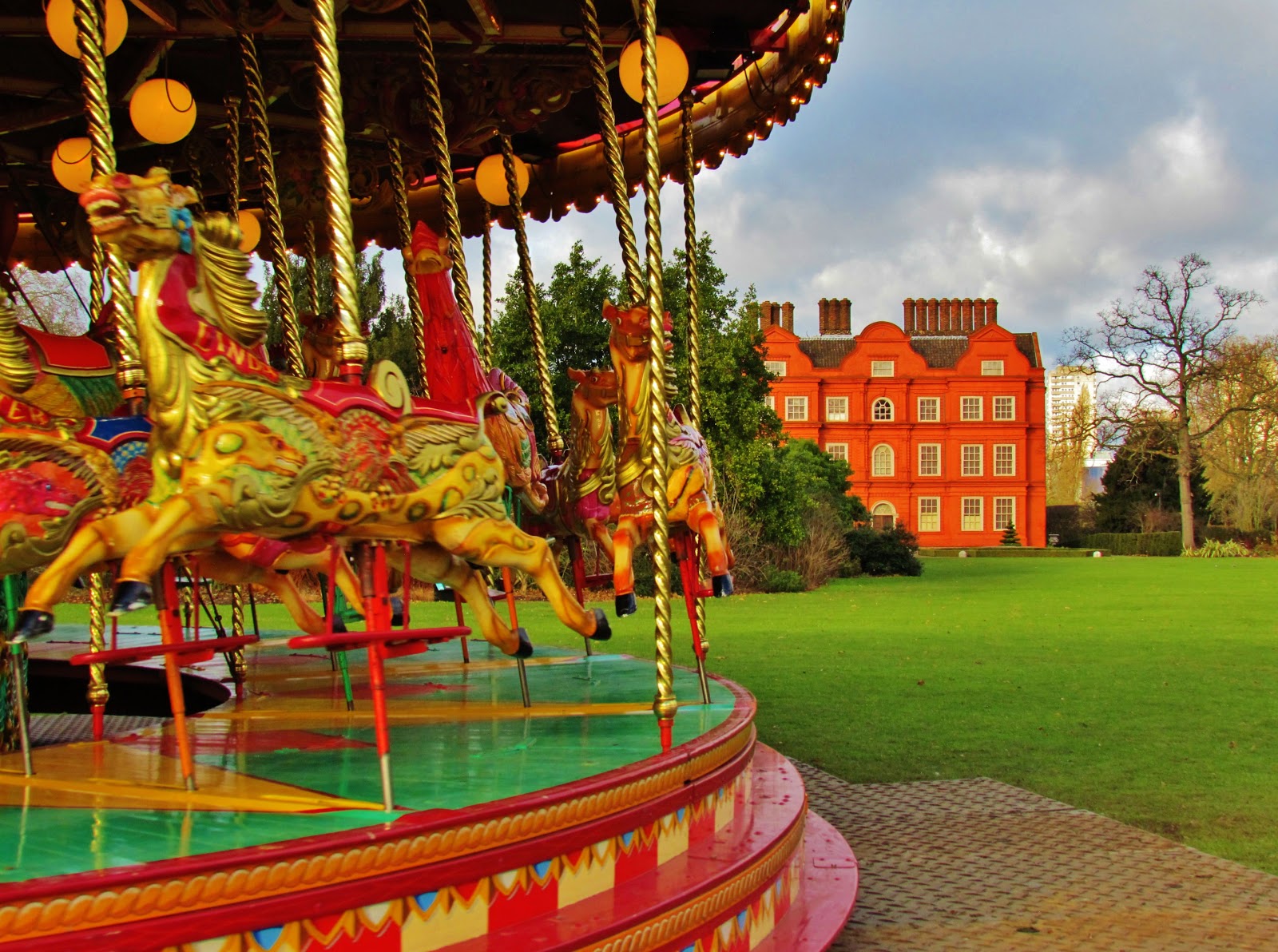
Kew Gardens have just set up the holiday carousel near Kew Palace.  Perfect photo op.


This is Liongate at Kew Grardens - quintessential in a cloudless sky.


This is the Chokushi-Mon gate at Kew Gardens, truly beautiful at any time of year.


This taken in October with the pagoda at back.


The garden below the gate is in such contrast to British gardens; far more controlled and manicured.


This is the Temple of Aeolus near the Palm House in Kew Gardens; looks like an Elysian idyll.


Another carousel on Southbank near the Eye. So glad that these old attractions are maintained and still tour the country.


I took this picture of of Regent Street from Oxford Circus.  Looks like there's a halo around the BBC; how ironic during its recent scandal.


Trafalgar Square with Whitehall and Houses of Parliament in the background, taken from the steps of the National Gallery.


And a view of Piccadilly Circus from Leicester Square.


Our beautiful kitten, Bowie; her first Christmas on earth.


I never tire of this view of the Thames from Richmond Hill.


While driving through Richmond Park last weekend, I caught a glimpse of St. Matthias's church in the distance.  I went back on foot on Wednesday to get this photo across the field.  This just doesn't look like London; it looks like a rural setting in Somerset; somehow it reassures me that there does exist some stability, peace and continuity in the world.

Monday, 10 December 2012

Coping with Leadership

There are many characteristics of leaders that are trotted out as being crucial for their personal success and that of the organisations which they manage and lead.  A shortlist of these traits includes superior cognitive skills and knowledge, fortitude, persuasiveness, decisiveness, charisma, authenticity, insightfulness, personality and character.  Obviously these range from ‘harder’ almost measurable qualities to those which are more a matter of subjective impression.

Managers and leaders are barraged with advice from consultants, TED gurus and the bookshelves of airport concession shops: be flexible & adaptable, be firm & have more of a backbone, keep it simple, deal with complexity, adapt, stick to your strengths.  Really, is it any wonder leaders who take this stuff seriously don’t become bipolar with the apparent conflicting advice.  Management is a notoriously trendy academic discipline; one of the best critics of guff at its most absurd is Lucy Kellaway of the Financial Times and author of Who moved my Blackberry.  One of the trends I’ve noticed becoming more and more prominent in blogs and articles in the Twitterverse is management and leadership theories based on the truth claims and practices of Eastern spirituality.


A meditative practice which is receiving an enormous amount of attention these days – and not just in the pages of the Sunday Times Style section. Psychologies magazine or Oprah – is mindfulness.  It doesn't surprise me when these periodicals promote the latest, trendiest pop psychology ‘findings’, but mindfulness is being sold by management consultants and bloggers at the Harvard Business Review, which I find deeply alarming.  According to a specialist in the worldviews and practices of eastern religion, Marcia Montenegro, mindfulness isn't just a meditative practice but is an outlook on life derived from the Zen Buddhist notion of detachment; "detachment in Buddhism is necessary because Buddhism teaches that attachment to this world, to your thinking, to your identity as an individual self, and other attachments, such as desires, keep you in the cycle of rebirth.”

Now those who give mindfulness a go and sing its praises might say that these things are not of interest to them; it’s stress-relief and a break from ‘over thinking’ that they’re hoping to achieve so that in the end they can become better, more effective managers and leaders. 

Take Bill George in a recent HBR blog, “Mindfulness helps you become a better Leader.”  When he was executive vice president of Honeywell in the 1980s he says, “I was caught up with external measures of success instead of looking inward to measure my success as a human and a leader.  I was losing my way.”  George tried a TM workshop in 1974 and now considers meditation to be a key component of his daily routine; he says it has helped him to "stay calmer and more focused in my leadership, without losing the “edge” that I believed had made me successful.  Meditation enabled me to cast off the many trivial worries that once possessed me and gain clarity about what was really important.  I gradually became more self-aware and more sensitive to the impact I was having on others.  Just as important, my blood pressure returned to normal and stayed there.”  He also says that he never adopted the spiritual portion of TM but that the physical practice has become an integral part of his daily life.

Another example is Peter Bregman’s recent HBR blogpost, "Try Meditation to strengthen your Resilience".  Bregman is also is a keen proponent of meditation which he began to practice in order to find relief from the highs and lows of emotions he felt as a result of the various sorts of feedback he received from his writing and presenting.  He explains, “unless you find solid footing in your consistent, unshakable Self, you’ll be thrown off balance and lose your way.  You’ll change your mind at the first resistance.  You’ll become overconfident when praise abounds. And you’ll make poor decisions, just to feel better.”  Bregman says that he was in search of “something more solid, an alternative to being tossed around by external events that didn’t rely on pretence.”


He goes on to say that he found the solution to his problem in meditation: “As I followed my breath in and out, I noticed something I hadn’t paid much attention to before.  And paying attention to it changed everything.”  Through meditation, Bregman claims that he was able to find his unshakable Self which would help him to maintain his "equanimity, peace, clarity and judgment in the face of changing circumstances and pressures".  Meditation, he believes, allowed him to see that this 'Self' is always there, “watching.”  He then goes on to encourage readers of his blog to try meditation for themselves rather than taking his word for its benefits.  The result of concentrating on one’s breath, he says, will be that “you will notice that your mind is thinking about something…the person noticing those thoughts?  That’s you. That’s your Self.”

Bregman says, "you are not your thinking.  You are the person watching your thinking."  The concept he's trying to articulate is the Buddhist notion of the witness or observer which is not strictly a person at all.  Nevertheless, Bregman believes that it is detachment which gives a person control over their thoughts and emotions and greater courage in the face of risky situations because, he claims, “you’ll know, no matter what happens, that you’ll be fine.”

Here’s the zinger of his article and the part I find most disturbing: “Having a strong relationship with your Self will make you incorruptible.”

What does that even mean?  It isn’t clear at all that this has anything to do with thinking or behaving in a moral manner.  It’s the detachment associated with mindfulness, the Buddhist seventh step of the Eightfold Path.  As Marcia Montenegro explains on her website, “if one practices mindfulness meditation on a fairly regular basis, that person may eventually adopt the worldview behind it, leading one to believe that the process of detachment is at work.  However, since the self is real, there can be no true detachment; therefore, no liberation or true peace results from mindfulness.  The techniques of mindfulness meditation lead one to enter an altered state, the same state one is in when under hypnosis.  In this state, the meditator’s critical thinking and judgement are suspended, and anything can enter the mind.”  She states in another article:

Mindfulness meditation is not designed for stress reduction or or to be a trendy dabbling for harried Westerners.  It is rigorously religious and strictly spiritual.

What bothers me about the accounts of these two men’s meditation experiences is that they appear to be buying into the meditation trend without critically considering its origin or purpose.  They're simply saying that they found something which they believe is enhancing their ability to lead by controlling their cognitive functions.  Since they don’t believe in a spiritual realm, they think that it isn’t playing any role in their meditative practice.  I think this is like ordering a mimosa for the orange juice and stating that the champagne won’t affect you because you don’t believe it in.  Whether something is true or not is not dependent on whether someone believes it to be true or not.  Meditation, as Christine Pack so elegantly puts it, is like spiritual crack: “entering into an altered state of consciousness is playing with spiritual dynamite, and not in a good way.”

Is coping with stress important to leaders?  Clearly.  Is meditation, mindful or otherwise, the best way to accomplish this?  Obviously not.  There are many ways to lower blood pressure and heart rate including hobbies, creating art, walking, listening to music, writing a poem, reading fiction or having a bath.  OK, so walking your dog isn't going to make it into the HBR's blog, but it's far better for one's physical, mental and emotional health than suspending one's rational thought in order to detach from reality.


The Worshippers Part 8: Visit to Richmond & Putney Unitarian Church

The Richmond & Putney Unitarian Church held its harvest celebration service the Sunday I attended on October 14th.  This is a lovely small church located in the historic area of Richmond in the road behind the Odeon Cinema.


Though I hadn’t been to a Unitarian service since we attended Rosslyn Hill Unitarian Chapel in Hampstead eighteen years ago, the readings and hymns of the service were all very familiar to me.  I also recognised the flame and chalice displayed on a banner hanging on the raised platform at the stained-glass end of the church.
  

There was a choir composed of around 10 men and women who elegantly and sonorously led the 25 congregants and guests through the hymns.  There was also a child's naming ceremony during the service.

The minister, Linda hart, told a story to illustrate some of the principles of the Unitarian faith.  It was the story of some crows who stole the entire harvest away from some animals who had painstakingly sewn, grown and planted it.  When the crows had come back to do some more scavenging, the animals didn't scold or reject them, but rather welcomed the crows and allowed them to share in the next harvest, for which the crows were surprised, but grateful.  I think the point of the story was to illustrate the aims and purposes of the Unitarian church which are these:

We are a congregation with open hearts and open minds.  We gather to celebrate the blessings of life, to support each other and to join with others who follow a spiritual path.  Our purposes are to promote spiritual enquiry in a welcoming, fellowship based on non-discrimination and care for others and to help people of all religious traditions and none find their own spiritual path based on exploration, questioning, insight, intuition and reason.[1]

The key themes of the sermon were to do with inclusion, tolerance and a non-judgmental attitude.  Which seems very mature and reasonable.  But I think there's something vital that's missing.  What about wrong-doing and justice?  The crows seriously ripped off the animals.  And though it's a beautiful thing to welcome them back to the table, to just forget the misdead isn't the same thing as to forgive.  It's forgiveness which wipes the slate clean.  I got the impression that, as in the Christian Science faith and some sects of the New Age, the concept of evil is sidestepped; it's presented as an illusion, therefore no foregiveness is necessary.  Can life work like that?  Certainly not in the secular world, which is why we have courts and prisons.  In the  Christian Kingdom, a price must be paid for sin and this was accomplished through the atonement at the crucifixion.  This is how some people are able to forgive seemingly heinous crimes, because they know that they've been forgiven.  Sotierology is totally absent from many faiths that claim Christian heritage.  The gospel isn't the focus of that heritage for them; I think they look to Jesus as a good teacher.  But as Tim Keller has said many times, the gospel isn't good advice, it's good news.  That's the meaning of sotierology.  In the reverend’s story the theft isn’t acknowledged at all; instead we skip straight to a fairy tale conclusion that all will be well. 


After the service, I was able to talk to some members of the church who were genuinely warm, helpful and candid.  I told them about my project to which they expressed support and interest.  They said that their service often included guests from other faiths such as Buddhism, as the notions of loving kindness and compassion were tenets that the two faiths shared in common.  I was also told that some members are interested in Buddist practices such as bhavana meditation.

Places such as the Unitarian church and the Quaker meeting house I visited earlier in the month are the churches in which I really sense that anyone would be welcomed and – crucially – would not feel intimidated or judged.  People should feel that way about Christian churches but, sadly, many probably don’t.

[1] The Flame, Richmond & Putney Unitarian Church Newsletter, October 2012.

The Worshippers Part 7: Visit to Quaker Meeting House

The Sunday morning I visited the Quaker Meeting house in Retreat Road, Richmond was quintessentially autumnal: clear, crisp and sleepy.  The meeting house is located down a beautiful small cul-de-sac off Richmond Green very close to the Thames tow path.


The structure is in fact an enormous Georgian house currently under renovation (located where it is, it must be worth a fortune).


I arrived a few minutes late for the 10.30 meeting, but was able to wait in the foyer with one of the church elders who told me we could go into the meeting room with any other stranglers at around 10.45.  She was very warm, welcoming and amenable when I explained the purpose of my visit.

We entered at the arranged short break time, took our places and the door was closed – this time, for the rest of the meeting.  There were around 20 ‘friends’ and I seated in a large lounge, mostly around the perimeter of the room, with some additional seating in rows in an adjacent space.  We sat in silence for around 45 minutes; some with eyes closed, others with eyes open.  There was a single reading which broke up the silence around 5 minutes into the worship – a short couple of sentences about sharing the faith with younger generations. 

According to their literature, Quakers believe:

We can worship alone, but when we join with others in expectant waiting we may discover a deeper sense of God’s presence.  We seek a gathered stillness in our meetings for worship so that all may feel the power of God’s love drawing us together and leading us….Yield yourself and all your outward concerns to God’s guidance so that you may find the evil weakening in you and the good raised up.[1]

At the end of the meeting I was able to chat to two members of the congregation who were open to sharing with me their beliefs as well as willing to hear about my experiences in the various stops I’d made on my faith journey.

The Quakers, I learned, do not espouse any single belief system or set of doctrines; rather they believe that everyone can find their own personal path by entering the silence.  Some meditate, though others do not.   They believe that each person has a particular experience of God and must each find his or way to be true to it.  This also from the literature:

As Friends we commit ourselves to a way of worship which allows God to teach and transform us. We have found corporately that the Spirit, if rightly followed, will lead us into truth, unity and love: all our testimonies grow from this leading….Friends maintain that expressions of faith must be related to personal  experience…The deeper realities of our faith are beyond precise verbal formulation and our way of worship on silent waiting testifies to this.[2]

I found this interesting sentence among the Advices and Queries booklet: "Are you open to the healing power of God’s love?  Cherish that of God within you, so that this love may grow in you and guide you.  Remember that Christianity is not a notion but a way.”[3] I have difficulty with this; the new age ‘ground of being’ is a notion.  The Tao is a way.  Christianity is neither a notion nor a way.  It’s a person.

The idea or tenet that truth is found by going deep within sounds laudable; but it isn’t difficult to see that when some look deep within and act on intuitive impulses, the resulting behaviour can actually be destructive.  Again from the literature, “Respect the laws of the state but let your first loyalty be to God’s purposes.  If you feel impelled by strong conviction to break the law, search your conscience deeply."[4]

One of the Friends I spoke with was rather disdainful of the doctrines and practices of the Christian faith.  I’ve noticed this quite a lot – that there is often disgust expressed for the church, Christian practices and the gospel.   And whereas it is right that we Christians are convicted when others point out where our actions and beliefs contradict one another (hypocrisy); it seems nonetheless difficult to accept a faith whose bedrock is personal, autonomous truth.  I don’t understand how one can assert relativism with regard to ultimate reality without denying it.  The Quaker Way puts it like this: 

It should not be imagined, however, that Quakers are impossibly 'good' people.  Like others they have faults and fall short of their own aims.  Nor do they claim that their path is the only true one, they have simply found it right for them.[5]


[1] Advices & Queries, The Yearly Meeting of the Religious Society of Friends (Quakers) in Britain, 2009, based on writings of George Fax, 1656.
[2] Ibid.
[3] Ibid.
[4] Ibid.
[5] "The Quaker Way." www.quaker.org.uk